
Delulu Thinking: Why Believing You Can is Half the Battle
I hate / love to tell you they were right...

Want to know a secret about mindset? It's one of the few areas where you get to control the narrative. You literally get to pick how you look at things.
It seems so simple, and I know it’s definitely not.
Overthinking.
Imposter Syndrome.
Fear.
But in a world where a lot is out of your control, why let others control what you think of you? Take control of your mindset.
Believing you can is critical to your progress. It’s not ‘a nice to have’, but a must. There are multiple psychological and neurological studies to show that self belief dramatically improves results. But don’t take my word for it, let’s deep dive into some of these studies.
🤭Side note: I’m not a psychologist or neuroscientist, but I do like facts! I’ll leave research links below.

The Self-Efficacy theory
The Self-Efficacy theory1 explores the link between believing you can succeed and actually doing so. The study shows that believing ‘I can do this’ will strongly indicate that you actually will. Introduced by Albert Bandura (1977), the theory states that if someone believes they can do something they are more likely to do so due to factors like more effort and more persistence put in. On the flip side, doubting yourself means you are more likely to give up or not do the task altogether.
This theory therefore argues that we all have the potential to be successful if presented with the right opportunities, and the main determinant of whether we will be, is our self-belief.
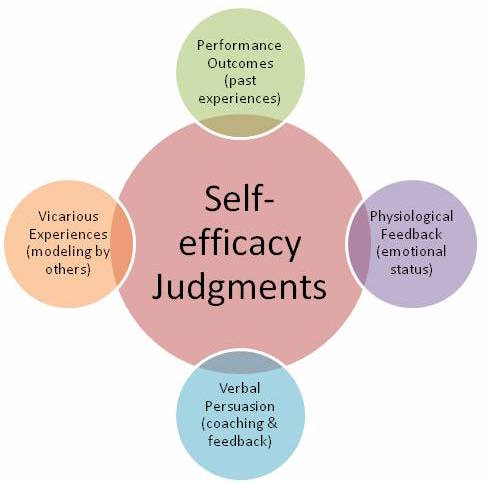
Ouch. Knowing we may be our own enemy in progress? Tough pill to swallow. But how do we grow our self-efficacy? Bandura stated 4 key ways2:
Past Performances - Having past successful performances will make you more confident to do it again. If you’ve successfully signed a client, or had a successful pop up shop, the thought of doing it again is less daunting.
Action: Focus more on the action than on planning and talking
Vicarious Experiences - Seeing the success of other entrepreneurs, especially those close to you, will make you think, if they can do it I can too!
Action: Find 3 entrepreneurs you are inspired by and read up on their journeys
Verbal Persuasion - Receiving encouragement from other trusted people, but even more importantly, positive self-talk. How you speak about yourself has an impact!
Action: Take note to what voices you listen to, and focus on speaking nicely to yourself
Physiological states - Your emotional state will have an affect on your self-efficacy, fear and anxiety are emotional states your body wouldn't expect success. And the strongest way to overcome this? Is through ‘participant modelling’. Aka feeling the fear and doing it anyway - the more reps you do, the more likely success is going to come.
Action: Track how you feel throughout the week. Do some tasks make you more anxious than others? Challenge yourself to one task a week that puts you outside your comfort zone
Learned Optimism
To first understand learned optimism, it’s best to look at the concept - learned helplessness. An experiment was conducted on dogs (sad ik!) in which researchers delivered unavoidable shocks. Later, in phase two of the experiment, the shocks became escapable but many of the dogs didn’t try to avoid them. Instead, they had given up, demonstrating what came to be known as learned helplessness.
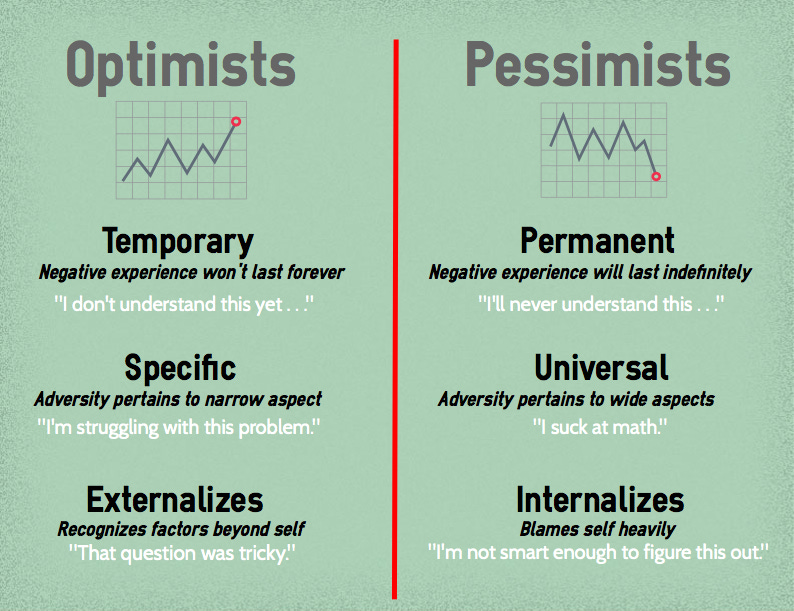
Building on this, Seligman (1967)3 went to study this concept on humans and found there were groups that resisted and were not helpless. He found that just like helplessness, optimism can be learned. By simply changing the way you view things it leads to resilience and perseverance.
In his book he gives the example of a sales agent who has received many nos, and “once they get discouraged…it takes more effort for them to get up and make the next call.” (Seligman, 2006, p.97)4. Seligman goes on to say that the self-talk post the calls is what prevents success, saying things like “I’m not good”, “I’m a bad salesman”, is speaking negatively about yourself in a permanent way. An optimistic person on the other hand would reframe this rejection - ‘maybe they were just too busy’ or ‘I didn’t call them at a convenient time’. This self-talk is not personal to you, but looks at the circumstances.
Change your mindset and watch your circumstances change
There’s a common theme. These studies show that changing your mindset is not for fun and games but it actually changes your brain's reactions and approaches to challenges and thus positively increases your chances of success.
And who doesn’t want to increase their chances of success?
So homework for today. Write down one goal, any goal that currently feels out of reach. I’ll start - building a solofounder community that provides value and comfort to solofounders. Now you have that goal, break it down and plan your first step. If you approach it with the right mindset, it suddenly feels a lot more possible, doesn’t it?
What’s that one goal that currently feels out of reach for you?